
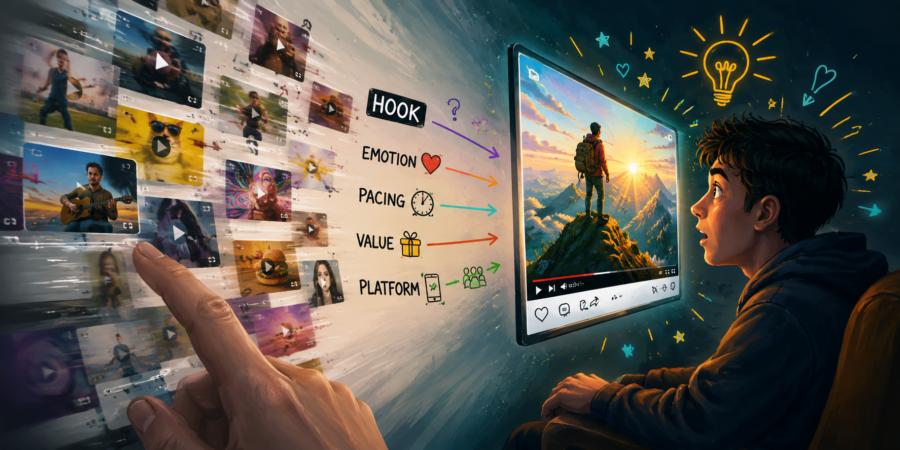
Video creators often assume attention is controlled by expensive cameras, cinematic lighting, or editing software with enough buttons to intimidate a spacecraft engineer. Those things can help, but they rarely decide whether people stay or leave. Most viewers are not grading production quality like judges at a film festival. They are making a rapid emotional decision about whether something feels worth their time.
Attention Starts Before Understanding
People often stop watching before they fully know what a video is about. That sounds unfair, but the feed is not a courtroom. It is more like a crowded market where every stall is shouting, juggling, discounting socks, and somehow selling smoothies. Your video has a tiny window to create a reason to stay.That reason does not need to be loud. It needs to be clear. A strong opening creates immediate tension, curiosity, usefulness, or recognition. “Here’s why your product videos are being ignored” is stronger than “Today we’re going to talk about content strategy.” One feels like it has arrived with a purpose. The other is still taking off its coat.
A good hook tells the viewer, quickly, what kind of reward is coming. That reward might be knowledge, relief, surprise, emotion, status, or entertainment. The viewer is silently asking, “Is this for me?” The opening must answer before the thumb gets restless.
Pacing Is the Pulse
Pacing is not about making everything frantic. A video that moves too fast can feel like being trapped inside a blender with captions. Effective pacing means the viewer never feels abandoned. Each moment should lead naturally to the next.For creators and small businesses, this means cutting the polite throat-clearing. Long introductions, repeated points, and slow setups are attention leaks. If a bakery is showing how it makes its best-selling cake, the video does not need fifteen seconds of someone walking toward the mixing bowl like it is a sacred monument. Get to the good bit.
Still, speed alone is not the answer. Serious topics need breathing room. Emotional stories need space. Educational content needs enough time for the idea to land. The trick is contrast: a quick opening, a clear progression, and moments of pause where the viewer can absorb the point.
The best videos feel shaped, not rushed. They respect the viewer’s time without treating them like a goldfish wearing headphones.
Emotion Keeps the Door Open
Information may attract attention, but emotion holds it. People keep watching when they feel something shifting: curiosity building, agreement forming, surprise arriving, or a problem becoming clearer. A video about accounting software can still have emotional pull if it speaks to the stress of messy invoices, late payments, and the small business owner whispering “not again” at a spreadsheet.This does not mean every video needs dramatic music or someone staring thoughtfully out of a rainy window. Emotion can be simple. Relief works. Recognition works. A tiny moment of honesty works. When viewers feel seen, they stay longer because the content has moved from “a video” to “a video about something I actually deal with.”
Creators often lose people by describing features instead of stakes. “Our app has automated reminders” is fine. “Stop chasing clients like a Victorian debt collector with Wi-Fi” is more memorable. The second version gives the viewer a situation, a feeling, and a reason to care.
Platform Behaviour Changes the Game
A video does not live in isolation. It lives inside a platform with its own habits, signals, and audience expectations. TikTok, Instagram Reels, YouTube Shorts, LinkedIn, and Facebook do not reward attention in exactly the same way. They each have different rhythms, viewing contexts, and reasons people open the app in the first place.On fast-moving platforms, the opening matters intensely because the viewer is already in swipe mode. On YouTube, a viewer may tolerate a slower build if the topic is specific and the promise is strong. On LinkedIn, clarity and usefulness often beat chaos. A dancing CEO might get views, but whether those views help the business is another matter entirely. The quarterly report is already nervous.
Good creators adapt without becoming robotic. They notice what the platform encourages, then shape their message to fit the environment. The aim is not to trick the algorithm. The aim is to make content that people complete, replay, share, save, or comment on because it gave them something worth reacting to.
Stop, Drop, and Scroll Control
Videos hold attention when they make a promise quickly, move with purpose, create emotional connection, and respect the platform they are on. Technical polish matters less than human relevance. A slightly imperfect video with a sharp idea will often beat a flawless video that says nothing slowly.For creators, marketers, and small businesses, the real question is not “How do we look more professional?” It is “Why would someone stop for this?” Answer that clearly, and the feed becomes less like a graveyard for forgotten posts and more like a stage where the right people actually pause.
Article kindly provided by videographymanchester.co.uk