
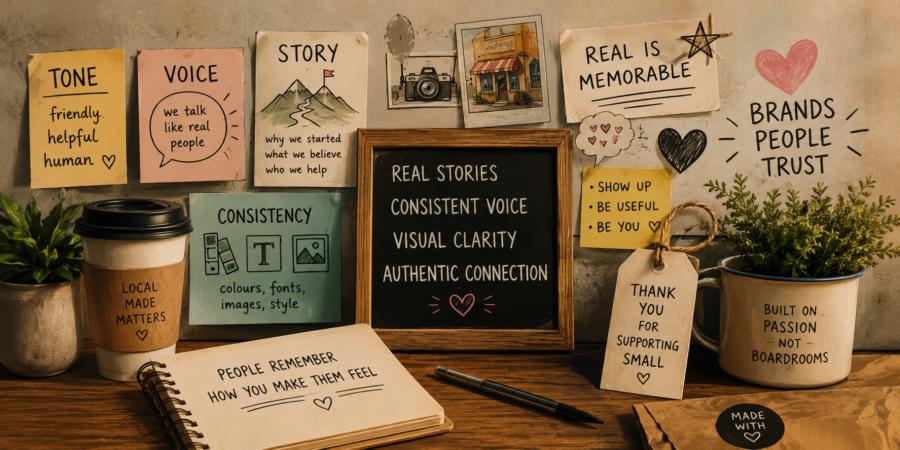
Large corporations often polish their branding until it resembles airport flooring—clean, functional, and strangely impossible to remember five minutes later. Small businesses have a different advantage. They can sound human, look approachable, and tell stories that do not require a committee approval stamp.
Identity Lives Beyond the Logo
A logo matters, but it is only one piece of the impression people carry away. A bakery is not remembered only because its sign has a whisk on it. People remember the handwritten labels, the smell of fresh bread, the owner who knows three generations of one family, and the Instagram captions that sound like someone who has definitely argued with sourdough at midnight.For startups, freelancers, and local businesses, identity comes from every repeated detail. The way you answer emails. The words on your website. The style of your photos. The packaging, invoices, menus, proposals, signs, thank-you notes, and tiny moments that say, “Yes, this is us.”
The goal is not to look bigger than you are. That often leads to bland branding with stock photos of people pointing at laptops in rooms where nobody has ever spilled coffee. The goal is to look clear, consistent, and trustworthy while still sounding like a real business run by real people.
Find a Voice People Can Recognise
Tone of voice is one of the most affordable branding tools available. It costs nothing to stop sounding like a brochure that swallowed a management textbook.A small business should decide how it wants to sound before writing anything public. Are you calm and expert? Warm and neighbourly? Bold and energetic? Dry and witty? Straightforward and practical? Pick a direction and use it everywhere, from your homepage to your order confirmation emails.
This does not mean forcing personality into every sentence. A tax adviser does not need to open every newsletter with a joke about spreadsheets wearing tiny hats. Some subjects need seriousness, precision, and restraint. Trust grows when the tone fits the moment.
Still, even serious brands can sound human. Replace stiff phrases with natural language. Say “We’ll reply within one business day” instead of “Your enquiry has been received and will be processed accordingly.” One sounds helpful. The other sounds like a printer became sentient and got promoted.
Stories Make Businesses Easier to Remember
People remember stories faster than specifications.Small businesses possess an advantage here that larger organisations often struggle to imitate. Their stories are usually real rather than carefully engineered.
Why did the business start? What problem frustrated you enough to do something about it? What values shape how you work? These details create emotional memory.
A local coffee shop may talk about family recipes and community gatherings. A freelance designer might explain how years of confusing client experiences inspired a simpler process. A startup could share early challenges without turning every post into a dramatic survival documentary narrated by invisible violins.
Storytelling works best when it stays grounded. Customers do not need mythology. They need context.
Some businesses avoid sharing stories because they fear sounding self-important. Yet silence creates its own problem. Without narrative, brands become interchangeable. Price becomes the main comparison, and nobody wants to win customers only by being the cheapest sandwich on the shelf.
Brand New Day
A memorable identity is built through steady choices. Speak in a voice people can recognise. Use visuals that feel connected. Share stories that explain why the business exists and why it matters.Small businesses do not need to imitate corporate branding to look credible. They need clarity, repetition, and enough personality to feel alive. The strongest identity is not the one that looks manufactured to perfection. It is the one customers can recognise, trust, and remember without needing a brand guidelines document thicker than a lasagne.
Article kindly provided by nulamedia.co.uk