
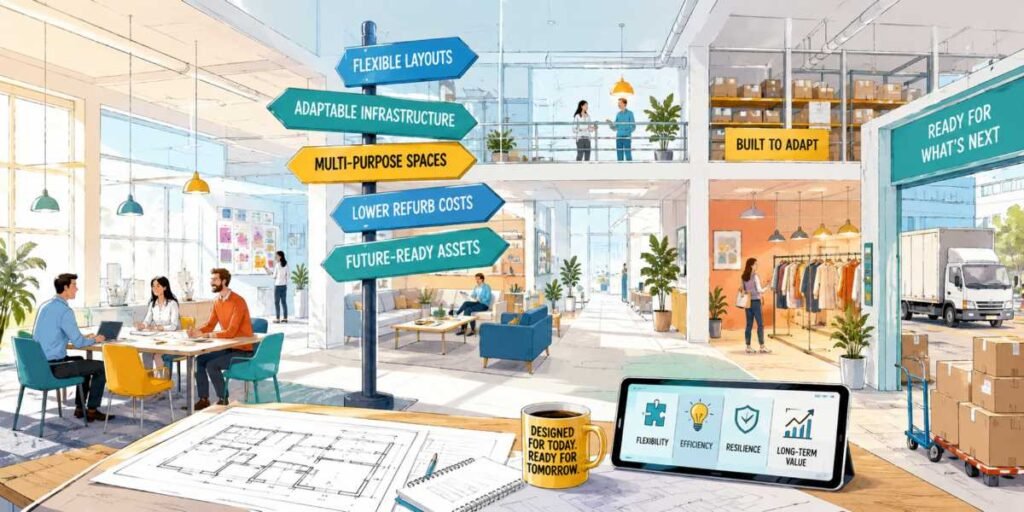
Commercial real estate has always involved a degree of uncertainty, but recent years have amplified that reality. Hybrid working patterns, changing consumer habits, technological advances, and economic fluctuations have altered what businesses need from physical space. As a result, future-proofing has become less of a luxury and more of a practical investment strategy.
Flexibility as a Design Principle
Flexible layouts are one of the most effective ways to improve the long-term resilience of a commercial property. Rather than creating highly specialised spaces that suit a single tenant profile, many property owners are embracing adaptable floorplans that can accommodate a wider variety of businesses.Open-plan environments often play a role here, but flexibility goes beyond removing walls. It involves designing spaces that can be divided, expanded, or reconfigured without major structural work. Demountable partitions, modular meeting rooms, and adaptable communal areas allow future tenants to shape the environment around their operational needs.
This approach can significantly reduce refurbishment costs between tenancies. Instead of spending months undoing expensive customisations, landlords can make relatively minor adjustments and return the space to market much faster.
A building that can comfortably host an accounting firm, a marketing agency, or a technology startup is usually more valuable than one designed exclusively around a single type of occupant.
Infrastructure That Can Grow With Demand
Tenants frequently outgrow a building’s infrastructure before they outgrow the physical space itself.Electrical capacity, internet connectivity, ventilation systems, and power distribution are increasingly important considerations. Businesses depend on technology more than ever, and future occupiers may require capabilities that seem excessive today.
Installing adaptable infrastructure during refurbishment or construction can save substantial costs later. Extra conduit routes, accessible service zones, raised floors, and scalable electrical systems provide room for future expansion without requiring disruptive building works.
There is little glamour in discussing cable pathways. Nobody attends a property viewing and announces, “Look at those beautifully planned service routes.” Yet these hidden elements often determine whether a building remains attractive ten years from now.
Infrastructure should be viewed as a long-term asset rather than a short-term expense. Businesses may change, but the need for reliable utilities rarely goes out of fashion.
Creating Spaces With Multiple Uses
Multi-purpose spaces provide another layer of protection against market uncertainty.Areas that can serve several functions create flexibility for both current and future tenants. A large meeting room might become a training facility, event space, collaborative workspace, or temporary project hub depending on operational requirements.
Properties that offer this level of versatility often appeal to a broader tenant base.
- Shared meeting facilities
- Flexible breakout areas
- Convertible storage zones
- Adaptable reception and waiting spaces
Some buildings become so narrowly tailored that replacing a departing tenant feels like trying to sell somebody else’s custom-made wedding suit. Multi-purpose design helps avoid that situation.
Reducing Refurbishment Costs Between Tenancies
Tenant turnover is an unavoidable part of commercial property ownership. What can be controlled is the cost and disruption associated with preparing a space for its next occupant.Future-proofed properties are designed with transition in mind. Durable materials, standardised fittings, and adaptable layouts make it easier to refresh a building without extensive reconstruction. Every wall that does not need moving and every system that does not need replacing contributes to lower vacancy costs.
From an investment perspective, shorter void periods can be just as valuable as rental growth. A property generating income sooner often outperforms one that spends months undergoing costly alterations.
Facilities managers also benefit from buildings that are easier to maintain and adapt. Instead of constantly responding to structural limitations, they can focus on operational efficiency and tenant satisfaction.
Planning for Changing Workplace Expectations
Commercial spaces are increasingly expected to support a variety of working styles. Businesses want environments that can accommodate collaboration, concentration, client meetings, remote workers, and evolving technology requirements.Property owners cannot predict every future trend, but they can create buildings capable of adapting to changing expectations.
Natural light, efficient environmental controls, quality acoustic design, and flexible communal areas continue to attract occupiers across multiple sectors. These features provide lasting value because they address fundamental human and operational needs rather than temporary fashions.
A brightly coloured slide connecting two office floors might generate excitement for a while. Explaining its business value to the next tenant could prove slightly more challenging.
The most resilient properties tend to prioritise adaptability over novelty.
Thinking Beyond the Current Lease
Serious investors often evaluate properties over decades rather than years. This perspective changes how design decisions are approached.Every refurbishment presents a choice. Owners can optimise exclusively for the current tenant or invest in solutions that create broader long-term appeal. While future-proofing may involve higher initial expenditure, it frequently delivers stronger returns through reduced adaptation costs, increased marketability, and greater occupancy resilience.
Buildings that can evolve alongside market demands are less vulnerable to economic shifts and sector-specific downturns. They attract a wider pool of potential occupiers and provide more options when leasing conditions change.
This is particularly important in an era where predicting business requirements even five years ahead has become increasingly difficult.
Building a Property That Refuses to Stand Still
Future-proofing commercial space is ultimately about accepting uncertainty rather than resisting it. Markets will change. Tenant priorities will shift. Technologies that seem cutting-edge today may become ordinary remarkably quickly.Flexible layouts, adaptable infrastructure, and multi-purpose design provide a practical framework for responding to those changes. They help reduce refurbishment costs, support stronger occupancy rates, and protect long-term asset value.
Commercial buildings do not need to predict the future perfectly. They simply need enough flexibility to welcome it when it arrives. The properties that achieve this balance are often the ones that remain relevant, competitive, and profitable long after neighbouring buildings have started asking expensive questions about their next reinvention.
Article kindly provided by homerenovationserviceslondon.co.uk