
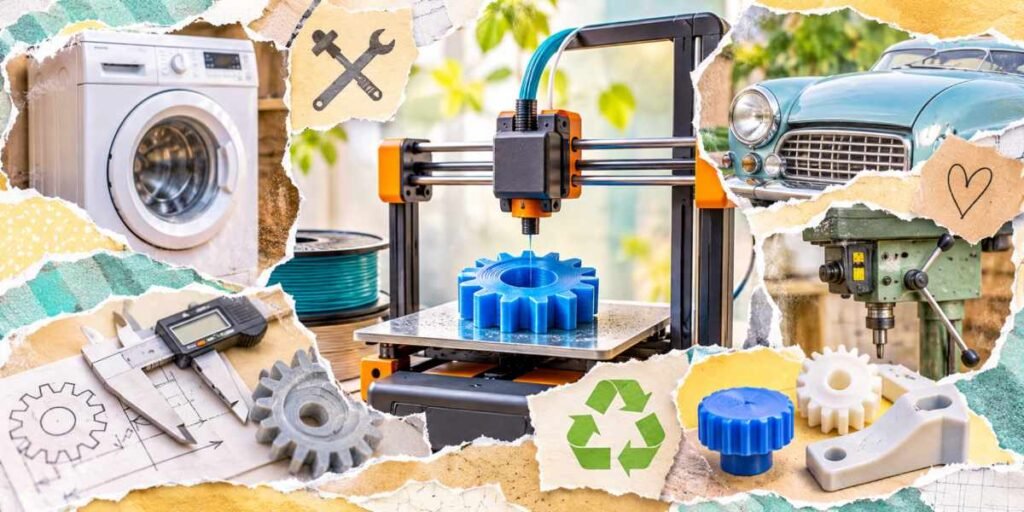
Fortunately, 3D printing offers another possibility. By recreating discontinued components, owners can extend the useful lives of household appliances, vintage vehicles, workshop machinery and specialist equipment. What was once an impossible repair may now require little more than accurate measurements, suitable software and access to a capable printer.
When Manufacturers Move On
Manufacturers cannot realistically stock replacement components forever. Production lines change, suppliers disappear, and maintaining inventories for decades-old equipment becomes commercially unattractive. Unfortunately, the equipment itself may remain perfectly functional long after its spare parts have vanished.This creates an especially frustrating situation with plastic components. Small gears, knobs, brackets, clips, covers and mounting fixtures frequently fail before the larger mechanical assemblies surrounding them. A broken plastic handle might render an expensive machine inconvenient or unusable despite everything else working perfectly.
Vintage vehicle enthusiasts encounter similar problems. Dashboard switches, ventilation controls and interior trim fittings can become extraordinarily difficult to obtain. Occasionally, an original component appears on an auction website at a price suggesting it was recovered from an Egyptian tomb rather than a 1987 hatchback.
3D printing can provide a practical alternative, particularly when the missing component has a relatively simple shape and performs a non-critical function.
Reverse Engineering a Broken Component
Recreating a discontinued part begins with understanding its original design. If the broken component still exists, even in several pieces, it can provide valuable information about dimensions, mounting points and mechanical relationships.Digital calipers are particularly useful for measuring thicknesses, diameters, hole positions and other important features. Measurements should be taken from undamaged areas wherever possible, since worn or distorted surfaces can produce misleading results.
Computer-aided design software allows these measurements to be converted into a three-dimensional model. The designer can reconstruct missing sections, reproduce mounting features and sometimes improve weaknesses in the original design.
However, copying every detail is not always desirable. An original component might have failed because its walls were too thin or its mounting tabs concentrated stress in one vulnerable location. Carefully strengthening these features may produce a replacement that lasts longer.
The surrounding assembly matters just as much as the broken component. Measuring the available space, checking clearances and examining how neighbouring parts interact can prevent expensive mistakes. A beautifully printed gear that cannot fit inside its housing is ultimately just an unusually elaborate paperweight.
Choosing Materials That Can Handle the Job
Not all 3D printing materials are suitable for every application. PLA, one of the most commonly used printing plastics, is inexpensive and relatively easy to work with. However, its limited heat resistance makes it unsuitable for components exposed to elevated temperatures, such as parts fitted near vehicle engines or heating elements.PETG offers improved toughness and temperature resistance, making it useful for many household and workshop applications. ABS and ASA provide additional heat resistance, although they require more demanding printing conditions. Nylon can be particularly valuable for components requiring toughness, flexibility or resistance to repeated mechanical stress.
Material selection should consider operating temperature, exposure to chemicals, mechanical loads and environmental conditions. A replacement bracket fitted outdoors may need ultraviolet resistance, while a component inside a dishwasher must tolerate repeated heating, moisture and cleaning chemicals.
Even the strongest material will disappoint if the printing process is poorly configured. Layer orientation, wall thickness, internal structure and printing temperature all influence durability. A component subjected to repeated pulling forces may fail along its printed layers if its orientation has not been carefully considered.
Knowing When Not to Print
3D printing is remarkably versatile, but it is not a universal replacement for conventional manufacturing. Components involved in braking systems, steering mechanisms, electrical safety, high-pressure equipment or other safety-critical functions should not be casually reproduced using consumer-grade printing equipment.Printed plastics can behave differently from injection-moulded originals. Their strength may vary according to printing direction, and internal imperfections can introduce weaknesses that are difficult to detect visually. A component that appears perfectly solid might fail unexpectedly under sustained loading or repeated vibration.
Food-contact applications also require particular caution. Material composition, surface porosity and cleaning requirements must be considered before using printed components around food or drinking water.
Sometimes conventional machining, professional manufacturing or purchasing a compatible replacement assembly will be safer and more economical. There is little satisfaction in saving twenty pounds on a component if its failure subsequently destroys a machine worth several thousand.
A Second Life, Layer by Layer
One particularly valuable aspect of 3D printing is the ability to produce components individually. Traditional manufacturing often requires expensive tooling and minimum production quantities, whereas additive manufacturing can create a single replacement without establishing an entire production line.This makes the technology especially attractive for maintaining ageing equipment, preserving vintage machinery and supporting specialist devices with limited commercial demand. Digital designs can also be stored and reproduced whenever another replacement becomes necessary.
Of course, accurate modelling and successful printing require patience. Several prototypes may be needed before a component fits correctly, and some designs will require professional assistance. Nevertheless, the potential savings in money, materials and unnecessary equipment disposal can be substantial.
Perhaps the greatest achievement is not producing another plastic object, but preventing an otherwise functional machine from becoming waste. When a tiny discontinued component threatens to send an entire appliance to the scrapyard, manufacturing a replacement offers something increasingly rare in modern consumer culture: the opportunity to repair rather than replace.
And somewhere, that eleven-pence washing machine clip can finally stop holding the entire household to ransom.
Article kindly provided by i-am3d.com