
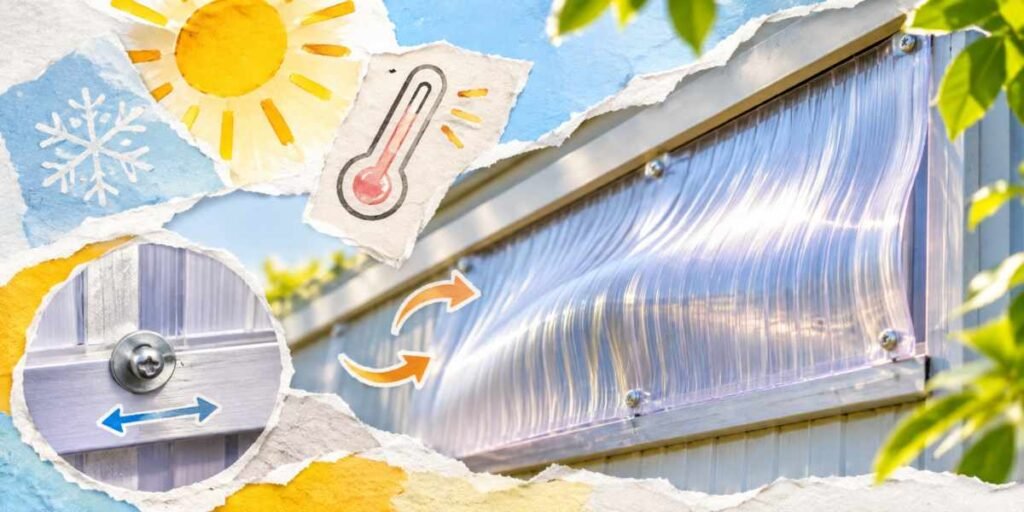
Most construction materials expand when heated and contract when cooled. This movement is generally small over short distances, but across several metres it can become substantial. Plastic sheets, metal cladding, composite panels and even concrete experience dimensional changes. Problems arise when installations prevent these materials from moving naturally.
Why a Few Millimetres Can Become a Major Headache
Thermal expansion sounds harmless until several millimetres of additional material attempt to occupy space that simply does not exist. A rigidly secured panel cannot negotiate with its surroundings. Instead, it may bow outward, crack around fasteners or place excessive pressure on adjoining components.Different materials expand at different rates. Many plastics exhibit considerably greater thermal movement than steel or concrete. Consequently, attaching a large plastic sheet tightly to a metal framework can create problems when the two materials respond differently to temperature changes. One component wants to stretch while the other remains comparatively stubborn.
These failures rarely announce themselves immediately. Installations completed during cooler weather may appear flawless until exposed to prolonged summer heat. By then, the original contractor may have forgotten the project entirely, making the eventual telephone conversation particularly entertaining for everyone except the person paying for repairs.
Expansion Gaps Are Not Installation Mistakes
Leaving deliberate spaces between panels or around their edges might seem counterintuitive, particularly when customers expect neat, tightly fitted surfaces. However, properly calculated expansion gaps are essential for many construction materials.The required allowance depends on the material’s coefficient of thermal expansion, the dimensions of the component and the anticipated temperature range. Manufacturers commonly publish installation recommendations specifying suitable clearances.
Ignoring these instructions to achieve a visually tighter finish can create considerably uglier results later. A narrow, carefully concealed expansion gap is generally preferable to a large, highly visible buckle resembling a small mountain range.
Fasteners Need to Allow Some Freedom
Screws, bolts and rivets can become unexpected troublemakers when installed without considering thermal movement. Overtightened fasteners may prevent panels from expanding naturally, concentrating stress around fixing points.Depending on the material and application, oversized or slotted fixing holes, suitable washers and manufacturer-approved fastening systems can accommodate movement while maintaining secure attachment.
The objective is not to leave panels rattling in the wind. It is to secure them appropriately without turning every fixing into a miniature structural argument. Installers should also distinguish between fixed anchor points and sliding connections, ensuring movement occurs in the intended direction without compromising safety or stability.
Choosing Materials That Can Handle the Heat
Not all construction materials respond equally to temperature changes. Polycarbonate, acrylic, PVC and polyethylene, for example, have different expansion characteristics, making material selection an important part of preventing future problems. Choosing solely on price, appearance or durability without considering thermal behaviour can produce an installation that looks excellent in January and considerably less impressive by August.Colour also matters. Dark surfaces exposed to direct sunlight can become substantially hotter than the surrounding air, increasing thermal expansion beyond what installers might anticipate from weather forecasts alone. A black plastic panel facing afternoon sunshine may experience considerably greater temperature fluctuations than an identical white panel installed in a shaded location.
Manufacturers’ technical specifications should therefore be consulted before selecting materials, particularly for large external installations. Where significant temperature variations are expected, materials with lower expansion coefficients or installation systems specifically designed to accommodate movement may justify their additional cost.
The Weather Forecast Is Not an Installation Manual
One frequently overlooked consideration is the temperature at which materials are installed. A plastic sheet fitted during a particularly cold morning may already be significantly contracted. If insufficient expansion allowance is provided, subsequent warming can create considerable pressure against adjoining surfaces.Conversely, materials installed during extreme heat may contract noticeably when temperatures fall, potentially exposing gaps or placing strain on poorly positioned fixings.
Contractors should consider the expected operating temperature range rather than relying exclusively on conditions during installation. This is particularly important for outdoor structures, agricultural buildings, roofing systems and industrial environments where temperatures can fluctuate dramatically.
Documenting installation conditions, following manufacturer recommendations and checking expansion allowances before final fastening can prevent disputes months later. A few minutes spent reviewing technical specifications is considerably cheaper than returning to explain why a supposedly permanent installation has developed an unexpected architectural personality.
Designing for Movement Rather Than Fighting It
Successful installations recognise that thermal movement is unavoidable. Flexible joints, appropriate edge clearances, sliding fixings and compatible adjoining materials allow components to expand and contract without transferring excessive stress throughout the structure.Regular inspections can also identify early warning signs, including distorted panels, stressed fasteners, widening joints and unusual surface deformation. Addressing these symptoms promptly may prevent more extensive damage, particularly where compromised cladding or roofing could allow water to enter the building.
For commercial projects, clearly documenting acceptable tolerances and installation requirements helps establish responsibilities between designers, suppliers and contractors. Thermal expansion should be considered during planning rather than introduced as an explanation after something has gone spectacularly wrong.
Room to Grow Without Blowing the Budget
Construction materials are remarkably obedient in most respects, but they will not stop expanding simply because somebody has tightened a screw. Temperature changes are inevitable, and the resulting movement must be accommodated through thoughtful design, appropriate material selection and careful installation.The financial consequences of ignoring these principles can extend beyond replacing damaged panels. Labour costs, disrupted operations, damaged finishes and disagreements over responsibility can turn a minor oversight into an expensive exercise in hindsight.
Ultimately, allowing materials a little freedom is often the best way to keep an installation firmly under control. After all, a building should have room to expand without giving its owner a similarly expanding repair bill.
Article kindly provided by sandhillplastics.com