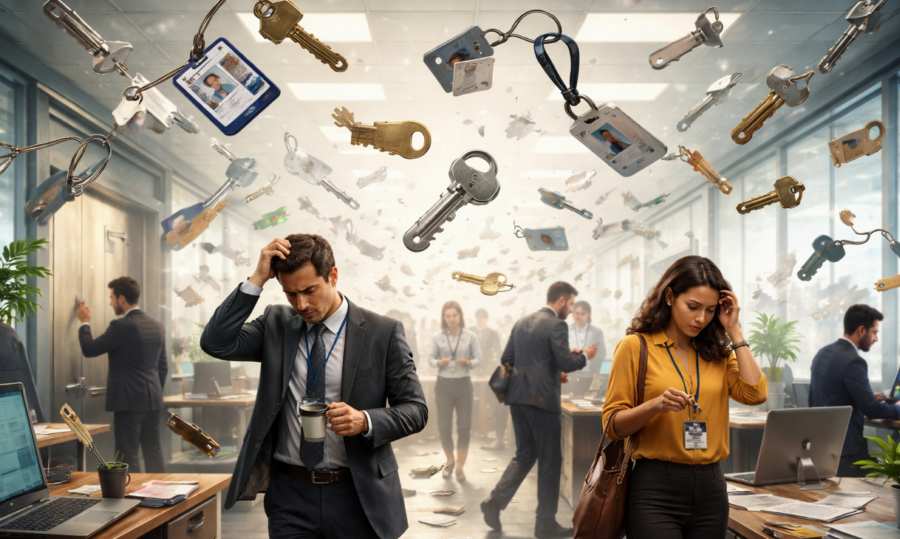
Modern offices like to imagine access control as a technical problem, but most of the friction happens well before any system is involved. People are moving quickly, juggling tasks, and trying not to be the bottleneck. Keys and passes become social objects, not just security tools. That shift in perception explains more misuse than any broken lock ever could.
Convenience Beats Policy Every Time
When deadlines loom and meetings overlap, convenience quietly rewrites the rules. Staff members are rarely thinking about access hierarchy or risk models when someone needs to grab something from a locked room. They are thinking about not being late, not interrupting their flow, and not looking unhelpful.Sharing a pass for “just a minute” feels harmless because the mental cost of saying no seems higher than the perceived security risk. Policies often exist, but they are abstract compared to the very real awkwardness of refusing a colleague who is standing right there. In these moments, security guidance competes with social instinct, and social instinct usually wins.
Stress Is a Natural Key Misplacement Engine
Stress has a remarkable ability to make small objects disappear. In busy offices, keys and passes are handled dozens of times a day, often while thinking about something else entirely. They get set down “for a second” on printers, windowsills, or the one desk that looks identical to every other desk.This is not carelessness in the moral sense. It is cognitive overload. When attention is split, objects without emotional weight drop out of awareness. Keys are functional, not memorable. They do not protest when abandoned, which makes them very easy to forget until they are urgently needed.
Blurred Ownership Creates Invisible Responsibility
One of the most serious issues is also the quietest. In many offices, it is unclear who truly “owns” a key or pass. Is it the individual? The team? Facilities? When responsibility is shared vaguely, accountability dissolves politely.If everyone assumes someone else is ultimately responsible, behavior shifts. Reporting a lost pass feels optional. Returning a borrowed key becomes flexible. The system relies on goodwill rather than clarity, and goodwill is not a reliable control mechanism under pressure.
Habits That Reduce Chaos Without More Tech
Better behavior does not require heavier systems or louder warnings. It usually comes from small structural changes that respect how people actually work.- Assign clear ownership for every key or pass, even shared ones
- Make reporting loss neutral, fast, and non-punitive
- Design workflows so access requests are normal, not awkward
- Review access habits regularly instead of only after incidents
Why Training Slides Rarely Change What People Do
Most offices have delivered some version of access control training. Slides were shown. Boxes were ticked. Everyone nodded at roughly the same time. Then real work resumed, and behavior quietly snapped back to normal. This is not because people are stubborn. It is because information alone rarely survives contact with daily pressure.Training often explains what people should do, but not why they fail to do it at 4:47 pm when a client is waiting and the printer has jammed again. When rules ignore emotional and time pressures, they become background noise. Effective guidance acknowledges shortcuts openly and then designs safer alternatives that feel just as fast.
Social Proof and the Copycat Effect
People take cues from what others appear to do. If sharing passes looks normal, it becomes normal. If no one visibly logs key returns, no one feels odd skipping it. This effect spreads quietly and efficiently, often faster than any formal process can correct it.Managers play an outsized role here, whether they mean to or not. When senior staff casually bypass procedures, it sends a stronger message than any policy document. On the flip side, when leaders follow access rules without fuss or fanfare, it resets expectations without a single email being sent.
Small Design Tweaks That Change Behavior
Many access problems are design problems in disguise. If returning a key requires effort, people will delay it. If requesting access feels embarrassing, people will borrow instead. Behavior follows the path of least resistance with impressive consistency.Simple physical and procedural cues help more than lectures. Clearly labeled return points, visible sign-out boards, and predictable access windows reduce decision fatigue. When the “right” action is also the easiest one, compliance stops feeling like compliance and starts feeling like common sense.
When Misuse Signals Something Deeper
Occasionally, lost or shared keys are not the problem but the symptom. Chronic misuse can point to understaffing, unrealistic workloads, or unclear authority lines. In those environments, access rules feel like obstacles rather than safeguards.Taking misuse seriously does not always mean tightening control. Sometimes it means asking harder questions about how work actually gets done. Security improves when systems support productivity instead of competing with it.
Key Takeaways Without Losing the Keys
Office access issues live at the intersection of psychology, habit, and design. People are not trying to undermine security; they are trying to get through the day with minimal friction. The more an office understands that reality, the easier it becomes to build access discipline that sticks.Clear ownership, humane processes, visible leadership behavior, and thoughtful design outperform complex controls every time. When access systems align with how humans actually behave, keys and passes stop wandering off quite so often, and everyone gets to spend less time retracing their steps.
Article kindly provided by hyperlocksmiths.co.uk