
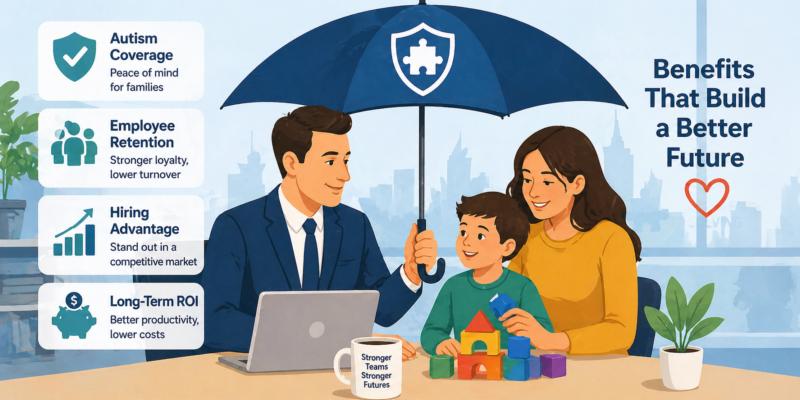
Autism coverage, including access to therapies like Applied Behavior Analysis (ABA), is starting to stand out in a way many employers didn’t anticipate. Not because it’s flashy, but because it signals something deeper: awareness, practicality, and a willingness to support employees beyond surface-level perks.
Why This Benefit Is Getting Noticed
Employees with neurodivergent dependents are often navigating a complex system of care, scheduling, and costs. When an employer-sponsored health plan includes autism-related coverage, it removes a layer of friction that otherwise follows them into the workday.That reduction in friction has real consequences. Less time spent battling insurance paperwork means more focus during working hours. Fewer financial surprises mean less stress. These aren’t abstract ideas—they directly affect performance, attendance, and long-term engagement.
For employers, the advantage is subtle but powerful. A company that supports families in practical ways becomes harder to leave, even when another offer includes a slightly higher salary. It’s difficult to compete with stability once someone has it.
Legal Expectations Are Raising the Floor
Across the United States, many states have mandates requiring insurance plans to cover autism-related services to some extent. These laws establish a baseline, but they don’t guarantee that all employer plans are equal.Some plans meet only the minimum requirements. Others go further, offering broader provider networks, fewer restrictions, and more comprehensive support. That difference is where competitive advantage begins to take shape.
Employers who treat compliance as the finish line often miss the opportunity. Those who see it as a starting point can design benefits that genuinely improve employee experience rather than simply checking a regulatory box.
Cost Conversations That Miss the Bigger Picture
It’s easy to focus on the upfront cost of adding or expanding autism coverage. Health plans aren’t cheap, and no one is casually adding line items for fun. But looking only at immediate expenses ignores what happens when support is absent.Turnover is expensive. Recruiting, onboarding, and training new employees adds up quickly. When employees leave because their benefits don’t meet their family’s needs, the cost isn’t just financial—it’s operational disruption.
There’s also the less visible cost of disengagement. Employees who are stretched thin managing care logistics often bring that strain into their work. It’s not a matter of effort; it’s a matter of bandwidth.
Providing meaningful coverage can ease that pressure. It won’t eliminate every challenge, but it can remove enough obstacles to make a measurable difference in how employees show up and stay.
What Strong Coverage Actually Includes
Not all autism coverage delivers the same value. Employers evaluating plans should look beyond whether ABA is technically included and examine how accessible it really is.- Clear eligibility criteria that employees can understand without needing a legal dictionary
- A provider network that isn’t so limited it turns scheduling into a competitive sport
- Reasonable session limits that reflect actual care needs
- Support resources that help employees navigate the system
Retention Gets Personal Faster Than Expected
Employees don’t usually announce that they’re evaluating benefits with the intensity of a contract negotiation, but the decision is happening quietly in the background. When a company provides autism coverage that genuinely works, it becomes part of an employee’s daily stability.That stability is difficult to replace. A higher salary might look appealing at first glance, but if it comes with uncertainty around healthcare, the equation changes quickly. People tend to stay where essential needs are reliably met, even if the office snacks are slightly less impressive.
There’s also a ripple effect. Employees who feel supported are more likely to speak positively about their workplace. Word travels—sometimes faster than official recruitment campaigns—and it often carries more credibility.
Hiring Advantage Without Saying Much
Employers don’t need to make grand statements about their benefits for candidates to notice. A well-structured health plan speaks for itself.Candidates researching potential employers are increasingly attentive to family-related benefits. Autism coverage signals that a company understands real-world challenges and is prepared to address them in a practical way. It also suggests that leadership is thinking long-term rather than focusing solely on short-term perks.
This creates a quiet advantage. While other companies compete on surface-level incentives, those with thoughtful benefits attract candidates who are looking for stability, not just novelty.
And stability, as it turns out, is remarkably persuasive.
Making Benefits Usable Instead of Decorative
Offering coverage is only part of the equation. Ensuring employees can actually use it is where many organizations fall short.Clear communication matters. Employees should know what’s covered, how to access it, and where to get help if something goes wrong. Without that clarity, even strong benefits can feel inaccessible.
Some companies are addressing this by pairing insurance coverage with internal guidance. HR teams or benefits coordinators can help employees navigate claims, find providers, and understand their options. It doesn’t require a massive program—just a willingness to make the system less confusing.
Because when benefits are easy to use, they stop being theoretical and start being valuable.
A Benefit That Builds More Than Coverage
Autism coverage in health plans isn’t just a line item. It reflects how a company approaches responsibility, planning, and employee support. These signals influence how employees feel about their workplace, even if they never consciously articulate it.Over time, those signals shape culture. A workplace that removes unnecessary stressors tends to see stronger engagement, better collaboration, and fewer sudden departures. None of this happens overnight, but the direction becomes clear.
Employers often look for dramatic strategies to stand out. In reality, thoughtful benefits that solve real problems tend to do the job more effectively.
Coverage That Covers More Ground
A health plan that includes meaningful autism support doesn’t just check a box—it strengthens the relationship between employer and employee in a way that’s hard to replicate. It reduces friction, builds trust, and quietly improves retention without requiring constant attention.It may not be the loudest feature in a benefits package, but it’s one that people remember. And when employees remember something for the right reasons, they tend to stick around long enough for that advantage to compound.
Article kindly provided by thetreetop.com