
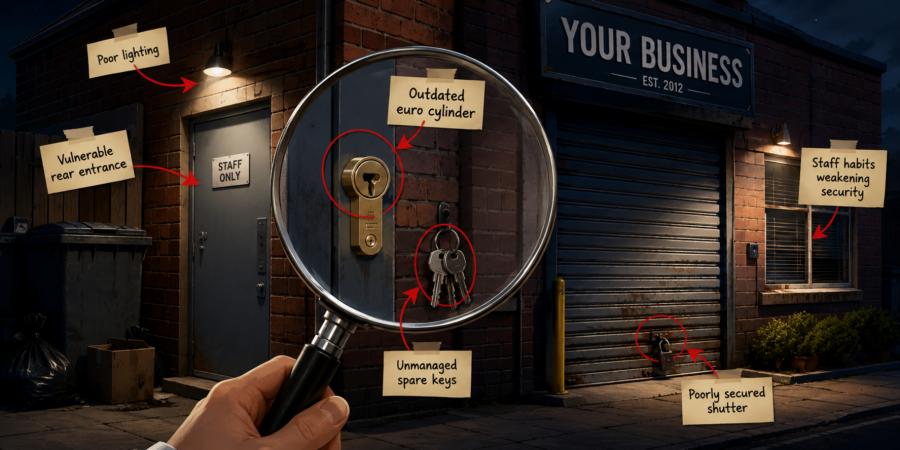
For many SMEs, security checks begin and end with locking up at night and hoping nobody tries anything ambitious. Unfortunately, opportunistic thieves tend to adore businesses with routines, blind spots, and locks that belong in a museum gift shop.
Retail units, cafés, warehouses, salons, workshops, and offices often share the same overlooked vulnerabilities. Most are not complicated. Most are not expensive to fix. What makes them dangerous is how normal they seem.
Rear Entrances That Practically Introduce Themselves
Front entrances usually receive attention because customers see them every day. Rear entrances, meanwhile, are frequently treated like the awkward cousin nobody speaks to at family events.Delivery doors, alley entrances, staff exits, and bin access points are common weak spots in commercial properties. They are often poorly lit, hidden from public view, and secured with older locks that have survived multiple business owners, three repaint jobs, and at least one emotional support padlock.
A determined intruder will almost always check the rear first. If the area is dark, shielded by fences, or blocked from street visibility, it becomes an easy testing ground.
Simple improvements make a major difference:
- Install motion-activated lighting
- Upgrade weak deadlocks and cylinders
- Trim overgrown shrubs and visual cover
- Add visible CCTV signage even if cameras are already present
- Check door frames for splitting or movement
Outdated Euro Cylinders Still Everywhere
A surprising number of commercial premises still rely on old euro cylinder locks vulnerable to snapping attacks. These locks can often be compromised within minutes using simple tools bought online without any dramatic cloak-and-dagger exchange in a rainy car park.The frustrating part is that many business owners assume a lock is secure simply because it turns and makes a reassuring click. Unfortunately, burglars rarely pause to admire the sound quality.
Modern anti-snap cylinders are far stronger and relatively affordable compared to the financial fallout of stolen stock, damaged doors, interrupted trading, and increased insurance premiums.
This issue becomes even more serious in businesses operating early mornings or late evenings. Bakers, pubs, convenience stores, and hospitality venues often leave staff entering or exiting during quieter hours when security weaknesses become far more attractive.
A proper lock assessment takes little time but can reveal vulnerabilities that have existed unnoticed for years.
The Chaos of Unmanaged Spare Keys
Some businesses operate key management systems that resemble archaeological digs. Nobody knows who has what, several keys vanished sometime around 2019, and one former employee still possibly possesses access to the stockroom despite now living in another county with a strong dislike for management.This is far more common than many owners admit.
Spare keys frequently end up:
- Inside unlocked drawers
- Taped beneath counters
- Shared informally between staff
- Left untracked after resignations
- Stored in labelled key cabinets visible to visitors
Even basic measures help enormously. Maintain a key register. Record returns. Restrict duplication. Replace locks after staffing disputes or missing keys. None of this feels exciting, but neither does discovering someone entered the premises without triggering suspicion because they still had a perfectly functional key from two Christmas parties ago.
Roller Shutters That Look Tougher Than They Are
Roller shutters give many business owners a comforting sense of invincibility. They rattle downward at closing time with enough noise to suggest a medieval fortress is being sealed for the evening. Unfortunately, appearance and effectiveness are not always close friends.Older shutters often suffer from weakened anchors, worn motors, bent tracks, or low-grade padlocks that would struggle to protect a biscuit tin. Some businesses install excellent shutters but neglect the surrounding structure entirely. Protecting a vulnerable frame with a heavy-duty shutter is a bit like wearing a motorcycle helmet with flip-flops.
Poor shutter maintenance also creates operational problems. Jammed systems can trap staff outside, delay opening times, and create expensive emergency repair situations during busy periods.
Regular servicing matters. So does checking:
- Lock quality and mounting points
- Manual override systems
- Track alignment and corrosion
- Signs of lifting or leverage damage
- External access to shutter controls
Lighting That Accidentally Helps Intruders
Bad lighting creates more than an unflattering atmosphere for employees taking bins out at closing time. It also provides concealment.Businesses frequently install bright lighting at the front while leaving side passages and loading areas dim enough to resemble abandoned film sets. Consistent external lighting discourages opportunistic activity because visibility increases risk.
Motion lighting is especially effective for quieter locations. Sudden illumination attracts attention and removes cover. More importantly, it often unsettles anyone hoping to work unnoticed.
There is also a psychological factor at play. Premises that appear maintained and monitored are less attractive targets. Broken fixtures, flickering bulbs, and damaged signage quietly suggest neglect.
Security is rarely about creating an impenetrable building. It is about making your premises a frustrating option compared to the easier choices nearby.
Staff Habits That Quietly Undermine Security
Many business security failures begin long before anyone touches a lock.Doors propped open for convenience. Alarm codes shared casually with temporary staff. Fire exits left unsecured during smoke breaks. Delivery drivers waved into stock areas without verification. These habits slowly erode physical security until the building becomes vulnerable through routine rather than force.
The challenge is that convenience nearly always wins in busy environments. Hospitality venues during peak hours, warehouses under delivery pressure, and retail shops handling constant foot traffic naturally develop shortcuts.
Some shortcuts are harmless. Others create serious exposure.
Clear procedures help, but they only work if management follows them too. Employees notice very quickly when rules exist purely for decorative purposes.
Brief refresher training can prevent major problems later. It does not need to become a dramatic corporate seminar featuring seventy-two slides and a motivational quote from somebody climbing a mountain. Simple reminders delivered consistently are usually enough.
Lock Stock and Two Smoking Barrels
Physical security audits are often delayed because owners expect huge costs, major disruption, or intimidating technical jargon. In reality, many improvements are straightforward and affordable.Better locks, improved lighting, tighter key control, reinforced frames, and routine inspections dramatically reduce risk without turning a small business into a high-security compound guarded by fingerprint scanners and emotionally exhausted pigeons.
Most criminals target opportunity before complexity. They look for weak access points, predictable routines, poor visibility, and businesses that have not reviewed security in years.
Small weaknesses become expensive problems when ignored long enough. A loose frame, an outdated cylinder, or an untracked key may seem insignificant individually. Combined together, they create exactly the kind of environment opportunistic thieves hope to find.
Good security rarely announces itself loudly. Usually, it appears as a business that runs smoothly, closes properly, controls access carefully, and removes easy opportunities before somebody else notices them first.
Article kindly provided by dgmlocksmiths.co.uk