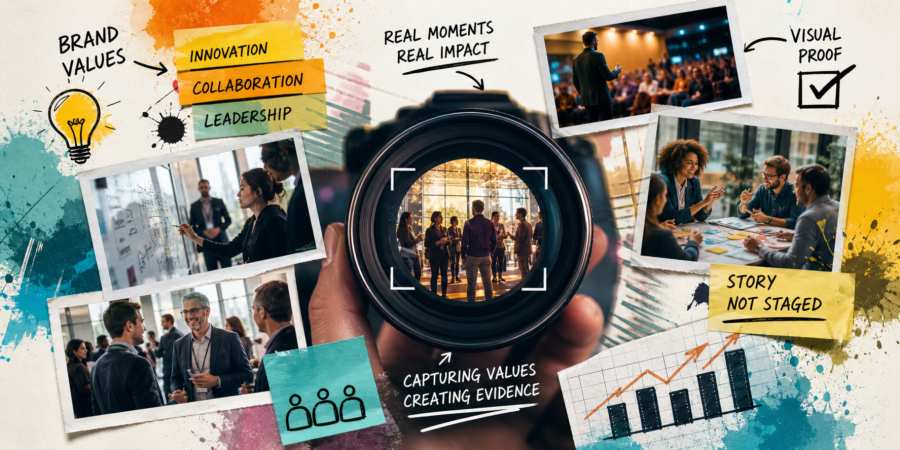
Corporate photography often defaults to safe territory: handshakes, speakers at podiums, polite applause. These images are technically correct and emotionally vacant. They don’t communicate innovation or collaboration; they communicate that everyone stood in roughly the right place at the right time. The challenge is to translate abstract brand values into moments that feel real without looking staged.
From Words to Observable Behavior
Brand values tend to live in polished documents, far removed from the hum of an actual event. “Innovation” sounds impressive until you have to photograph it. A useful shift is to treat each value as a set of observable behaviors rather than a concept.Innovation might look like someone sketching an idea mid-conversation, or a group leaning over a prototype with equal parts curiosity and skepticism. Collaboration could be a moment where hierarchy disappears—someone junior explaining something while a senior leader listens without interrupting. Leadership may show up not in keynote speeches, but in quiet, decisive interactions just before a session begins.
This approach forces clarity. If a value cannot be tied to a visible action, it’s unlikely to translate into an image that carries meaning. It also prevents the all-too-common scenario where “innovation” is represented by a glowing screen and a person pointing at it, as if pointing alone produces breakthroughs.
Identifying Moments Without Manufacturing Them
There is a fine line between capturing authenticity and accidentally directing a corporate theater production. The goal is not to stage moments but to anticipate them. That requires preparation that goes beyond a shot list.Before the event, map out where meaningful interactions are likely to occur. Workshops, informal networking areas, and transitional spaces—hallways, coffee lines, the awkward cluster around charging stations—often reveal more about a brand than the main stage. People behave differently when they are not being watched, or at least when they think they aren’t.
Photographers who succeed in this space tend to work like attentive observers rather than directors. They notice patterns: who gravitates toward whom, where energy builds, when conversations shift from polite to engaged. Then they position themselves accordingly, ready to capture the moment without interrupting it.
Of course, there will always be the occasional participant who freezes the instant a camera appears, adopting a posture last seen in a high school yearbook. This is less a failure of the subject and more a reminder that subtlety matters. The best images often come from blending into the background rather than announcing one’s presence with the enthusiasm of a marching band.
Aligning Visuals with Brand Strategy
Photography should not operate as a decorative afterthought. It needs to align with the broader brand strategy, which means understanding not just what the company says about itself, but what it is trying to prove.A practical framework involves three layers:
- Identify the core values that matter for this specific event, not the entire brand manifesto.
- Translate those values into observable behaviors and likely scenarios.
- Prioritize moments where multiple values intersect, as these tend to produce richer images.
Consistency is also critical. If a brand positions itself as forward-thinking, but the imagery feels dated or overly controlled, the disconnect becomes obvious. Visuals should reinforce the same narrative that marketing, product, and leadership are all trying to tell—without requiring a caption to explain what’s going on.
The result is a library of images that does more than document attendance. It demonstrates that the brand’s values are not just printed on banners but enacted in real interactions. And that, unlike a perfectly aligned handshake, is much harder to fake.
Reading the Room Like a Strategist
Strong event photography depends less on reflexes and more on interpretation. The photographer is not just reacting to movement; they are decoding intent. Every brand has its own rhythm—some events buzz with rapid-fire exchanges, while others unfold in quieter, more deliberate ways. Treating all environments the same produces a gallery that feels interchangeable.Understanding the event’s purpose sharpens the eye. A product launch demands attention to anticipation and reveal. A leadership summit leans toward moments of decision, influence, and reflection. When the intent is clear, the photographer can distinguish between noise and signal. Not every conversation is worth capturing. Some are simply about where lunch is being served, which, while important to morale, rarely communicates strategic vision.
Timing becomes a strategic tool. The first ten minutes of a session often carry a different energy than the last ten. Early moments show curiosity; later ones reveal engagement or fatigue. Both can be useful, depending on what the brand wants to emphasize. The key is to recognize when something meaningful is about to happen, rather than discovering it later while scrolling through hundreds of polite smiles.
Composition as a Message Carrier
What is included in a frame matters as much as the subject itself. Composition can reinforce or undermine the story being told. A single executive centered in isolation suggests authority, but it may conflict with a brand that emphasizes collaboration. Conversely, a tightly framed group exchange can communicate shared ownership and collective thinking.Small decisions add up. Shooting at eye level invites the viewer into the moment, while a slightly elevated angle can provide context and show relationships between participants. Depth of field can isolate a key interaction or situate it within a broader environment. None of these choices are neutral. Each one nudges the interpretation in a specific direction.
Background elements deserve scrutiny. A cluttered backdrop filled with irrelevant signage or distracted attendees dilutes the message. On the other hand, a well-chosen background—subtle branding, engaged participants, a visible artifact of work in progress—can amplify meaning without overwhelming the subject. It is the difference between an image that feels intentional and one that feels accidental.
Editing for Coherence, Not Just Quality
After the event, the real curation begins. Editing is often treated as a technical exercise: remove duplicates, correct exposure, select the sharpest frames. That is necessary but insufficient. The goal is not just a collection of good photos, but a coherent narrative.Images should be evaluated against the original intent. Do they collectively demonstrate the brand values identified at the start? Are there gaps where a value is underrepresented or missing entirely? A technically perfect image that does not serve the narrative is less useful than a slightly imperfect one that captures a genuine, relevant moment.
Variety also matters. A sequence of nearly identical interactions quickly becomes monotonous, even if each individual image is strong. The final selection should reflect a range of perspectives—wide shots that establish context, mid-range interactions that show engagement, and close-ups that capture nuance. Together, they create a visual argument rather than a random assortment.
Restraint is part of the process. Not every image needs to be included, and not every moment needs to be explained. The strongest sets leave space for interpretation while still guiding the viewer toward a clear understanding of what the brand stands for.
Picture This as Evidence
When done well, event photography stops behaving like decoration and starts functioning as proof. It shows that collaboration actually occurred, that leadership was exercised in real time, and that innovation was more than a line in a presentation.This kind of imagery holds up under scrutiny. It does not rely on exaggerated gestures or overly composed scenes. Instead, it reflects genuine interactions that align with the brand’s stated identity. Viewers may not consciously analyze each element, but they recognize authenticity when they see it.
Over time, these images accumulate into something valuable: a visual track record. They can be used across campaigns, internal communications, and stakeholder reports, each time reinforcing the same message without needing to restate it. The brand becomes visible through its actions, not just its language.
And if one or two photos happen to capture someone mid-bite or in the act of untangling a charging cable, that is simply part of the record. Even the most carefully planned event has its unscripted moments. The trick is knowing which ones to keep—and which ones are better left as a private reminder that behind every polished brand experience is a very human group of people trying to find an available outlet.
Article kindly provided by gdholland.co.uk