Rethinking the Workstation Footprint
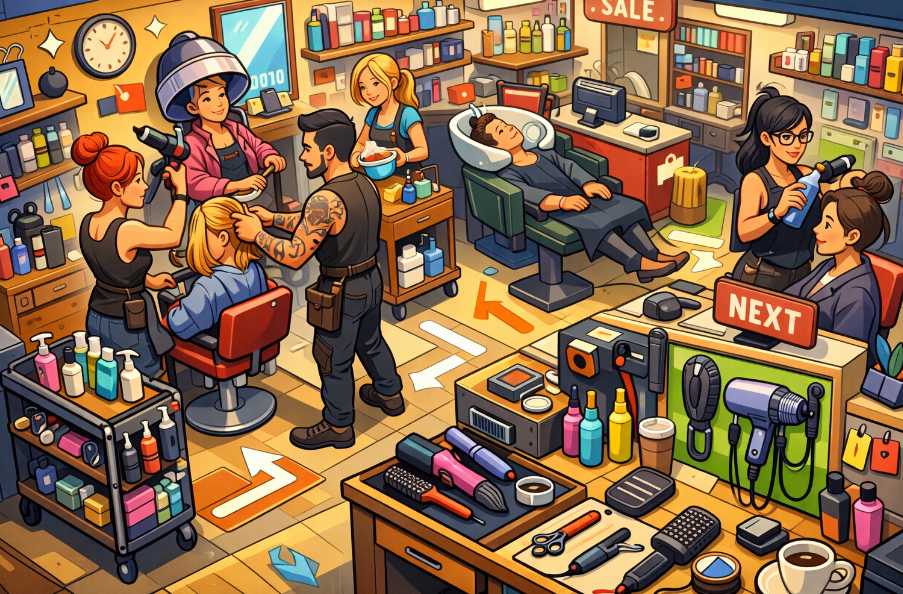
A workstation should function like a well-organized cockpit rather than a decorative display. If a stylist has to step away more than once or twice during a service, the layout is already costing time. Multiply that across a full day, and you’re effectively donating hours to the void.Position frequently used tools within arm’s reach. Not “lean slightly and hope,” but truly reachable without breaking workflow. This includes brushes, combs, sectioning clips, and heat tools. Storage that looks clean but forces extra movement is not efficient—it’s just tidy chaos.
Chairs, mirrors, and tool stations should form a tight triangle of movement. The goal is to minimize steps without making the space feel cramped. Stylists shouldn’t feel like they’re playing a game of human Tetris just to pick up a dryer.
Tool Placement That Actually Saves Time
Tools tend to migrate. A dryer starts the day in one place and ends up somewhere entirely different, usually when someone else needs it most. Without intentional placement, even the best equipment becomes a bottleneck.Create designated zones for shared tools and make them obvious. If a stylist has to think about where something belongs, the system has already failed. Consistency is more valuable than creativity here.
- Keep heat tools docked in the same position at every station
- Use wall-mounted holders to free up counter space
- Store backup tools nearby but out of the main workflow
Workflow Design That Reduces Traffic Jams
High-density salons often struggle with one invisible problem: people getting in each other’s way. When multiple stylists are working in close proximity, poor layout turns simple tasks into minor logistical challenges.Map out the natural flow of a service from start to finish. Where does the client enter? Where do they move for washing, cutting, and finishing? Every unnecessary crossing of paths increases the chance of delays.
Separate high-traffic zones from precision zones whenever possible. Washing stations, reception, and product displays tend to attract movement. Cutting and styling areas require focus and consistency. Mixing the two creates constant interruptions.
Some adjustments are surprisingly simple:
- Angle chairs slightly to prevent collisions behind stylists
- Create clear walking lanes that remain unobstructed
- Position retail displays away from active work areas
Storage That Supports Speed, Not Just Aesthetics
Minimalism looks great until someone needs a specific tool right now. Storage should prioritize access first and appearance second, even if that means slightly less visual perfection.Group items by function rather than category. For example, keep everything needed for a blow-dry together instead of separating tools and products into different areas. This reduces the number of steps required to complete a service.
Transparent or labeled storage can also prevent time loss. When everything looks identical from the outside, stylists end up opening multiple drawers just to find one item. Over the course of a day, those seconds quietly accumulate into lost productivity.
Efficiency in a small salon isn’t about squeezing more into the space. It’s about making every movement intentional. When layout, tools, and workflow align, the result isn’t just faster service—it’s a smoother, more controlled environment that benefits both staff and clients.
Designing for Multi-Tasking Without the Chaos
Stylists rarely do one thing at a time. Colour processes develop while another client is mid-cut, and someone, somewhere, is always waiting for a chair. A well-planned layout allows this overlap to happen smoothly rather than turning it into a juggling act with questionable odds.Position processing areas close enough to active stations so stylists can keep an eye on multiple clients without pacing back and forth. This reduces both physical fatigue and the subtle stress of constantly checking the clock. No one wants to sprint across the salon because a toner decided to develop faster than expected.
Flexible stations also help. Chairs and trolleys that can be repositioned quickly allow the space to adapt throughout the day. Morning appointments might be spaced out and relaxed, while peak hours demand tighter coordination. The layout should support both without requiring a full redesign at noon.
Reducing Setup and Reset Time Between Clients
Turnover time is often where efficiency quietly disappears. Even a few extra minutes between appointments can compound into lost revenue by the end of the day.Standardizing station resets is one of the simplest ways to recover that time. Every stylist should return their station to the same baseline setup after each client. This eliminates guesswork and ensures the next service starts without delay.
Consider creating a reset checklist that becomes second nature:
- Disinfect tools and surfaces immediately after use
- Return all tools to designated positions
- Restock essential products before the next client arrives
Lighting and Mirrors That Work With You
Lighting often gets treated as a design feature, but it plays a direct role in speed and accuracy. Poor lighting leads to second-guessing, rework, and longer service times.Position lighting to reduce shadows and ensure even visibility across the client’s head. This allows stylists to work confidently without constantly adjusting their angle or stepping back to check their progress.
Mirror placement also matters more than it seems. Properly aligned mirrors can reduce the need for repositioning clients during a service. Less repositioning means fewer interruptions, which translates to smoother workflow.
Small Adjustments That Deliver Big Gains
Not every improvement requires a renovation. Some of the most effective changes are subtle and inexpensive, yet they have an immediate impact on daily operations.Even shifting a trolley a few inches closer or relocating a frequently used product can remove dozens of unnecessary movements per day. Over time, those saved steps translate into measurable gains in both speed and energy.
Pay attention to recurring frustrations. If multiple stylists are encountering the same minor inconvenience, it’s likely a layout issue rather than a personal habit. Fixing it once can improve efficiency across the entire team.
Cutting Corners Without Cutting Quality
Maximizing output in a limited space isn’t about rushing services or squeezing in more clients at any cost. It’s about designing an environment where every action supports the next one, where tools are exactly where they should be, and where movement feels natural rather than forced.When a salon layout is working properly, it becomes almost invisible. Stylists move with confidence, clients feel at ease, and the day flows without constant adjustments. That kind of efficiency doesn’t come from working harder—it comes from working smarter, one square meter at a time.
Article kindly provided by csssalonsupplies.com