
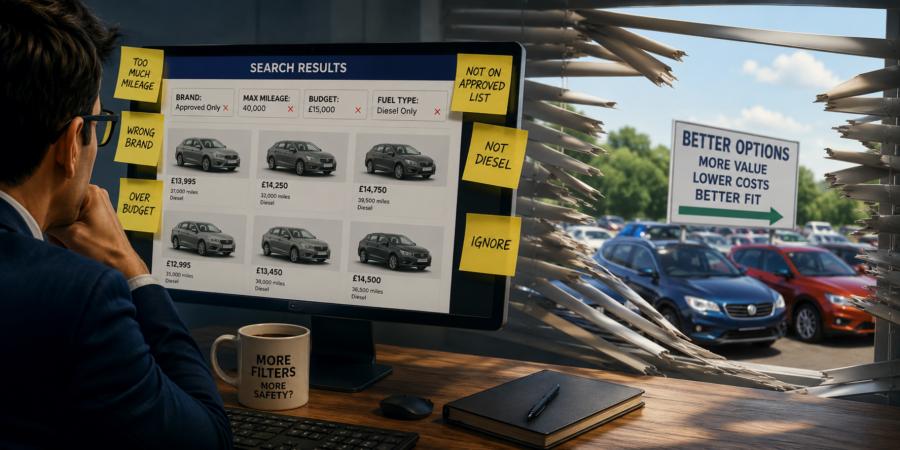
Company vehicle sourcing is often treated as a task of elimination. Remove anything over budget. Remove unfamiliar badges. Remove higher mileage examples. Remove certain fuel types. Remove anything that does not fit last year’s template. Before long, the shortlist looks impressively tidy and surprisingly uninspired.
That approach feels safe, which is exactly why it can become expensive.
When Filters Become Blindfolds
Procurement policies exist for good reasons. Businesses need consistency, cost control, and accountability. Nobody wants a fleet strategy based on whichever vehicle happened to catch someone’s eye while waiting for coffee.Yet strict filtering can quietly undermine those same goals.
A common example involves brand restrictions. Some organisations maintain preferred manufacturers based on historic relationships or assumptions about reliability. While consistency has advantages, brand loyalty can become strangely emotional in environments otherwise ruled by finance departments and approval workflows.
One badge becomes the trusted veteran while another is treated like an uninvited guest at the annual budget meeting.
The problem is that modern vehicle quality has shifted considerably. Reliability, safety systems, servicing costs, and resale values now vary widely within brands rather than neatly between them. A less fashionable manufacturer may offer lower ownership costs and better specification than the familiar choice sitting comfortably on the approved list.
Serious procurement decisions deserve current evidence rather than inherited assumptions.
Mileage Rules That Ignore Real Usage
Mileage limits create another frequent trap.Many teams establish hard ceilings, often rejecting anything above a fixed number without further assessment. The logic seems sensible. Lower mileage should mean less wear and lower risk.
Reality is less obedient.
A higher-mileage vehicle with comprehensive maintenance records and predominantly motorway use may represent stronger value than a lower-mileage alternative with patchy servicing and stop-start urban history. Numbers matter, but context matters more.
Procurement teams that rely on mileage alone risk paying premium prices for vehicles that merely look safer on paper.
There is also a practical business question worth asking. If a vehicle will cover substantial annual mileage anyway, does paying significantly more for an exceptionally low-mileage example always make commercial sense? Sometimes the answer is yes. Sometimes it is simply expensive optimism wearing a sensible tie.
Budget Caps and the Illusion of Savings
Budget discipline matters. Procurement teams are measured on financial performance, and vehicle sourcing rarely receives applause for creative overspending.Still, rigid purchase ceilings can produce unintended consequences.
A lower acquisition price does not automatically equal better value. Vehicles should be evaluated through a wider ownership lens that includes maintenance, fuel economy, insurance, downtime risk, and expected resale value.
This is where narrowly filtered searches become particularly costly.
A vehicle sitting slightly above the initial budget may deliver lower operating costs across several years of use. Meanwhile, the cheaper option can become a loyal companion to the workshop and a recurring line item nobody wants to discuss during quarterly reviews.
Finance departments have long memories. Vehicles with mechanical drama help keep those memories alive.
Procurement teams benefit from considering total cost of ownership rather than focusing exclusively on purchase price.
- Expected servicing and repair costs
- Fuel or charging efficiency
- Insurance group ratings
- Vehicle availability and downtime risk
- Residual value at disposal or resale
Smarter Searches Produce Better Shortlists
Improving procurement searches does not require abandoning policy or turning vehicle selection into a guessing game.It requires building flexibility into the process.
Rather than applying hard exclusions immediately, sourcing teams can use layered evaluation. Initial searches may include wider mileage ranges, additional manufacturers, or modest budget flexibility before vehicles are assessed against operational priorities.
This creates room for comparison instead of premature rejection.
Serious sourcing teams also benefit from reviewing market conditions regularly. Vehicle supply, resale demand, and fuel preferences change quickly. A filter strategy that worked two years ago may no longer reflect commercial reality.
Cross-department consultation can also improve decisions. Drivers, fleet managers, operations staff, and finance teams often notice different strengths and weaknesses. Procurement gains value when those perspectives inform sourcing criteria.
Not every employee needs a vote on company vehicles, of course. Otherwise the fleet shortlist may somehow include a convertible and something described internally as “aggressive but fun.”
The key point remains serious. Procurement should support operational performance, not merely enforce historical preferences.
Driving Change Without Stalling Progress
Vehicle procurement works best when filters guide decisions rather than dictate them.Strong sourcing strategies balance structure with adaptability. They recognise that brand reputation, mileage, and price remain important indicators but rarely tell the entire story on their own.
Businesses that review search criteria critically often uncover stronger value, broader choice, and more commercially effective vehicles. That does not mean buying recklessly or abandoning established standards. It means asking whether current filters still serve the organisation’s real objectives.
Company vehicle sourcing should be treated as a commercial decision shaped by evidence and operational needs, not by habits that have quietly gained policy status over time.
The strongest procurement teams are rarely the ones with the shortest shortlist. They are the ones that know when to widen the search before narrowing the decision.
A better fleet sometimes begins with something remarkably simple — removing a few digital blinkers before hitting the search button.
Article kindly provided by usedcarscrewe.uk