
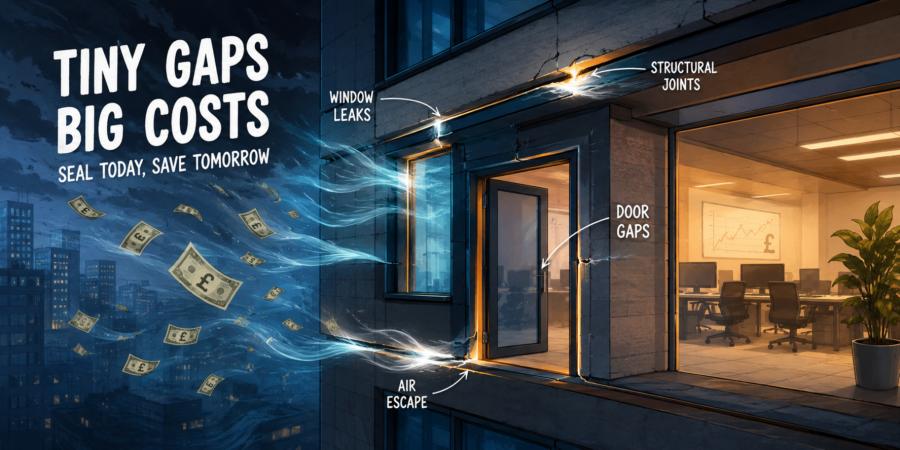
Air leakage is rarely dramatic enough to earn emergency meetings, but it is persistent enough to shape operational costs year after year. For commercial property owners and facilities teams, this invisible escape route often hides in plain sight.
Small Gaps With Large Appetites
A building envelope is designed to separate internal conditions from the weather outside. When that envelope contains poorly sealed junctions or ageing materials, it begins to behave less like a barrier and more like an unreliable handshake.Minor gaps commonly develop around:
- Window and door frames
- Expansion joints
- Curtain wall systems
- Service penetrations and pipe entries
- Connections between structural materials
Conditioned air follows the path of least resistance. Warm indoor air escaping during winter or cooled air leaking out during summer forces HVAC systems to work harder and longer. Equipment cycles increase, energy demand rises and operating expenses quietly climb.
Buildings, unfortunately, do not send polite apology letters for this behaviour.
Why Air Leakage Matters Beyond Utility Bills
Energy loss is only part of the story.Uncontrolled air movement affects temperature consistency throughout a commercial property. Occupants may notice hot and cold zones, draughts near glazing or meeting rooms that feel oddly tropical while corridors resemble early spring in northern Scotland.
Comfort issues translate into business consequences. Staff productivity, tenant satisfaction and workplace experience can all suffer when indoor conditions become unpredictable.
Serious commercial environments demand consistency. Warehouses, offices, healthcare settings and retail spaces depend on controlled internal conditions not merely for comfort, but for performance and operational reliability.
Moisture movement presents an additional concern. Air leakage can transport water vapour into concealed building areas where condensation forms. Over time this may contribute to deterioration, mould growth and material damage that extends far beyond higher energy invoices.
The expensive problems are often the ones nobody notices until someone points at a stained ceiling tile with growing concern.
Air Testing and the Numbers That Refuse to Lie
Commercial construction and refurbishment increasingly face pressure to meet stricter energy and environmental expectations. Air permeability testing has become a significant benchmark in this process.Air testing measures how much air leaks through the building envelope under controlled pressure conditions. Results provide clear evidence of whether a structure performs as intended or whether hidden weaknesses remain.
For developers and project teams, failing an air test can trigger delays, remedial work and unwelcome conversations involving revised schedules and rising costs.
This is where sealing strategies become more than finishing details. They influence measurable building performance.
Well-considered sealing around openings, structural transitions and service penetrations helps reduce uncontrolled leakage and improves the likelihood of meeting required standards. The difference between passing and failing is sometimes found in junctions that seemed too minor to deserve attention during earlier construction stages.
There is a familiar pattern in commercial projects. Major structural elements receive detailed planning, while small sealing details are occasionally treated like background extras waiting politely offstage. Unfortunately, air leakage does not respect hierarchy.
Operational Efficiency Starts at the Edges
Building efficiency is often discussed through impressive technology and large infrastructure upgrades. Smart controls, renewable systems and high-performance equipment all deserve attention. Yet operational efficiency also depends on whether the building retains the environment those systems create.A highly efficient HVAC installation working within a poorly sealed building resembles a premium coffee machine with a hole in the cup. The engineering may be excellent. The outcome remains disappointing.
Sealing strategies support operational performance in several practical ways:
- Reduced heating and cooling demand
- Improved indoor temperature stability
- Lower strain on mechanical systems
- Potential reduction in maintenance frequency
- Greater predictability in energy budgeting
Facilities managers often inherit leakage issues rather than create them. Ageing seals, building movement and repeated maintenance work can gradually compromise performance over time. Even high-quality properties require periodic assessment and upkeep.
Building movement deserves particular attention. Structures expand, contract and settle throughout their lifespan. Materials respond differently to temperature and moisture changes, meaning joints experience ongoing stress. Rigid or deteriorated sealing solutions may eventually fail, reopening pathways for air infiltration.
Closing Time Without Closing Shop
Energy efficiency discussions sometimes drift toward dramatic overhauls and eye-watering capital programmes. Yet meaningful savings frequently begin with quieter interventions.Reviewing and maintaining sealing performance is rarely glamorous work. Nobody gathers around a boardroom table to admire a well-sealed joint with misty-eyed admiration. Still, effective sealing protects operational efficiency, supports environmental targets and helps commercial buildings perform closer to their intended design.
Minor gaps may be small enough to overlook, but their financial impact rarely stays modest for long. When conditioned air escapes unnoticed, running costs rise with determined patience.
Commercial buildings cannot eliminate every operational challenge, but they should at least stop paying to heat or cool the outdoors. That arrangement has never been a sensible tenant agreement.
Article kindly provided by pioneersealantsltd.co.uk